
 Canva
Canva
Sometimes the plant world is stranger than fiction. These plants are very peculiar indeed – so odd that you must see them to believe them.
Many call Australia home, and if you think kangaroo paws or Sturt’s desert peas take the medals for the most alien-looking plants, here are a few more that are really out of this world.

Air plant
Tillandsia spp
There’s no need to get your hands dirty with these little darlings. Tillandsia, or air plants, don’t need soil to provide them with water and nutrients. Instead, they soak up minerals, moisture and decaying organic matter from the atmosphere around them through special leaf scales. Roots anchor the Tillandsia in place rather than take up nutrients.
The plant’s fountain of foliage is attractive enough, but its tubular flowers are astonishing, emerging in vibrant clashing hues from bright red and pink to purple and blue. When the flowers finish, little pups appear at the base.
Air plants thrive right across Central and South America, growing in tropical forests, mountains and deserts as epiphytes (where they cling to trees) or lithophytes (gripping rocks). They make a striking feature when arranged in pebbles in a terrarium, glued to driftwood or hanging from fishing lines.

Bat flower
Tacca chantrieri
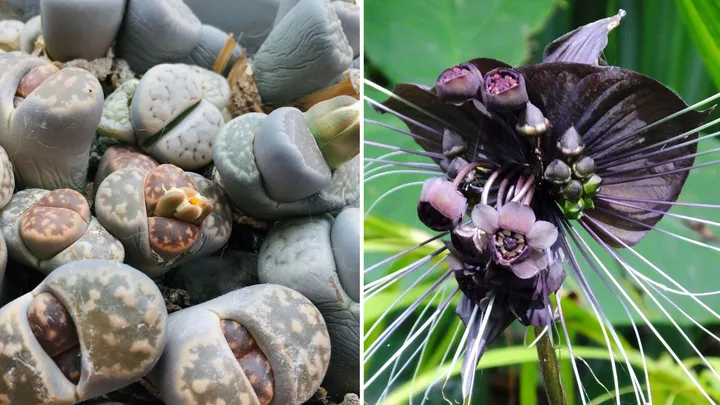
Get your goth gear on for this ghoulish, whiskery plant. Thriving in the tropical and humid areas of Australia’s deep north, the black or deep purple bracts of the bat flower look like the open wings of a flying bat. From the centre, up to 30 whisker-like bracteoles swing, each up to 25cm long.
The flowers themselves are tiny and gathered in bell-shaped clusters. The whole inflorescence, on show from spring to autumn, perches on top of a towering 50cm stalk that emerges through large, bright green, lance-like leaves. It prefers shady tropical and subtropical climates or warm, protected spots in a temperate area where the soil is moist and well-drained. And it does well in a pot.

Climbing sea onion
Bowiea volubilis
Despite its name, this is not an onion; it’s not edible, and it doesn’t grow in the sea. Instead, it’s a large scaly bulb that sits high above the soil, from which grow twining, snake-like, bright green stems with tiny, green-white flowers at their tips. The plant comes from the hot, dry regions of Africa, and its tangled, lacy stems have been modified to do all the photosynthesising. The stems grow up to 4m, twining around nearby vegetation, climbing through trellises or scrambling over rocky hillsides.
The plant goes dormant in winter when the stems wither, and you’re left with a large, fleshy, green-brown bulb that rests quietly during the cooler months. Every couple of years, it will produce offsets that grow and mature alongside the parent bulb. You can divide the bulbs in winter if it gets too crowded.
Grow it in gritty, well-drained soil or a potting mix suitable for succulents, and place it in part sun, part shade. Water during the growing season, but not in winter.

Lifesaver plant
Huernia zebrina
Cross a zebra with a starfish, and you get a little owl (another common name for this plant). These striking but tiny (2.5cm across) flowers bloom throughout summer, showing off zebra-striped red and yellow petals.
The glossy, rubbery red ring in the centre, which looks like a life buoy, gives this succulent its common name. The flowers sit on top of four-sided stems with soft spines along the edges. The stems are grey-green in low light, but take on a reddish tinge when in full sun.
Each flower lasts about a week. It looks spectacular, but also produces an unpleasant smell – a bit like decaying flesh – to attract pollinating flies. This is why it’s also known as the carrion flower. It’s often mistaken for a cactus, and although it isn’t one, it has the same care needs. Grow it in cactus potting mix in full light but with shade from the hot sun. Water moderately in summer but keep dry in winter.

Living stones
Lithops spp.
Masters of disguise, these cute, low-growing succulents get their name from their pebble-like appearance. Coming in shades of green, cream, grey, and brown, with darker markings, these patterns serve as camouflage against foraging herbivores. The little “babies’ bottoms” you see above the ground are two almost fused leaves, called window leaves, that allow the plant to photosynthesise. Sweet-smelling yellow or white flowers emerge from between the leaves in autumn, blooming in the afternoon and closing up at night.
In spring, two new leaves appear, and the old leaves wither and die. Underground are more leaves, and during droughts, the window leaves will also crawl beneath the surface.
Originally from southern Africa, these succulents thrive in coarse, well-drained soil or potting mix under a warm morning sun. But if they get too much water, the window leaves will expand and burst. A light drink every two weeks from mid-spring to summer keeps them happy.

Parachute plant
Ceropegia sandersonii
Straight out of Roswell or Area 51, this alien-looking flower has cruel intentions. From beneath its distinctive green, parachute-shaped flowers comes a citrusy scent that’s irresistible to a female fly looking for a safe, snug place to lay her eggs. She heads down to the base of the flower tube only to become trapped in a nest of hairs. As she wriggles to escape the hairs, she becomes covered with pollen. She only escapes imminent doom when the flower starts to die – its job done now that the next generation is assured. As the hairs loosen their grip, she can then flit off to another flower close by to deposit the pollen.
This unusual succulent with long vining stems and small, fleshy, heart-shaped leaves looks stunning cascading from hanging baskets or trained on a trellis. It’s native to the warm, humid areas of southern Africa. Grow it in a succulent potting mix and put it in bright, indirect light. Water the plant moderately during the growing season and keep it dry in winter.

Sundew
Drosera spp.
Sundew is a sweet name for a plant that indulges in such gruesome deeds. There are about 200 known species of this hairy monster, with more than half native to Australia. They all lure insects into their fold, suffocating then slowly digesting them. The prostrate leaves are covered with extremely sensitive and sticky hairs, each topped with a nectar gland. As soon as an insect tries to suck on this ‘dew’, the leaf curls around it and the feasting begins.
Sundews are usually found in moist, acidic and nutrient-deficient soils, such as bogs or swamps, and insects provide the nitrogen essential for survival. Another survival tactic is to produce flowers on long stems high above the leaves so pollinating insects don’t get trapped. Sundews are difficult to grow as a houseplant unless you imitate their natural environment – a moist, nutrient-poor growing medium and lots of sunlight. Water only with distilled or rainwater. If insects indoors aren’t your thing, spray leaves with liquid orchid food at half strength.

Related stories
Native ad body.
Native ad body.


Native ad body.