
Choosing a destination for your next holiday is often focused on experiences, events and of course, the food. But what if the best part of visiting a city is not what you’ll find to do there, but the city itself?
From the Pink City in Jaipur, India and the Blue City in Chefchaouen, Morocco, to the natural wonders of The Bay of Fires in Tasmania, there are bright and brilliant spots to visit that are full of colour! If you’re looking for colourful cities and natural landmarks that are worth a longer trip, these are the holiday destinations for you.
9 colourful cities to visit around the world

The Blue City
Chefchaouen, Morocco
What: Chefchaouen is called the ‘Blue Pearl’ of Morocco. It’s a beautiful place with buildings and homes washed in various shades of blue. From the late 1400s, the town was a refuge for people expelled from Spain, and it retains a unique blend of Spanish and Moroccan styles. Wander through the city’s historic Medina district to see public squares with traditional fountains, shaded alleys and centuries-old homes.
Where: Chefchaouen is at the foothills of the Rif Mountains, about a three-hour bus trip from Tangier.
When: Go in autumn (Sep–Nov) or spring (Mar–Apr) for fewer crowds.
Try: After haggling at the souks, visit the 15th-century Kasbah, with its interior garden and a museum.

The Pink City
Jaipur, India
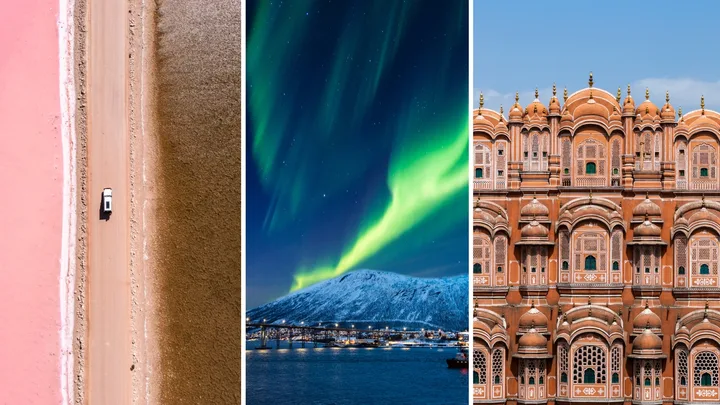
What: Jaipur, the Pink City of India, is a history buff’s dream. It was founded in 1727 as India’s first planned city and is a place of majestic palaces and imposing forts, parks and gardens. In 1876, it was painted pink – the colour of hospitality – when the Prince of Wales visited.
Where: Jaipur is 295km south-east of New Delhi and is Rajasthan’s capital.
When: Visit during the cooler winter months (Nov–Mar). To avoid the biggest crowds, try October or March.
Try: Don’t miss the pink City Palace and explore the ‘Palace of Winds’ (the Hawa Mahal, pictured above) with its cooling honeycomb of windows. The Jantar Mantar astronomical observatory, completed in 1734, is also fascinating.

The Huanglong Valley
Sichuan province, China
What: The Huanglong Valley, in China’s Sichuan province, is renowned for its snowy mountains, forests and a cascade of springs called the ‘Five Colour Pools’. The pools were formed in a stretch of travertine limestone, and sunlight reflecting off calcium sediments gives them otherworldly hues from emerald to yellow, milky blue and aqua.
Where: The pools are in the Huanglong Scenic Area, 370km from Sichuan’s capital, Chengdu.
When: Visit during the summer (Jun–Aug) to see the pools at their most vibrant.
Try: You can’t swim in these mineral-rich pools, but the view is worth the trip. The mountains and forest are equally beautiful.

Valparaiso
Chile
What: Do a walking tour of perhaps the world’s most colourful streets in the Chilean port city of Valparaiso. Houses in its historic quarter are painted in a rainbow of colours – a tradition that started when residents used leftover paint from the port on their homes. This cultural hotspot is renowned for its bohemian scene, and there’s a wealth of street art and murals to explore. But beware! The city is built on 42 hills, so pack comfy shoes. You’ll be climbing stairs or grabbing a ride on a funicular.
Where: Valparaiso is about an hour’s drive from Chile’s capital, Santiago.
When: Summer (Dec–Mar) is best for beach weather.
Try: Head to the quirky La Sebastiana House Museum, the former home of Nobel Prize-winning poet Pablo Neruda.

The Chocolate Hills
Bohol Island, Philippines
What: The Chocolate Hills span 50 sq km on Bohol island in the Philippines, with more than 1700 dome-shaped mounds turning chocolate brown each dry season as the grass fades. One legend says the hills were shaped by giant children making mud cakes. Another says they’re left over from a mud-slinging match between two feuding giants. Scientists explain them as grass-covered limestone karsts.
Where: Bohol is in the Central Visayas region of the Philippines and is easy to get to from tourist favourite Panglao Island.
When: Visit in the dry season (Nov–May) for the chocolate colour.
Try: For an extra special view, head for the hills during sunrise or sunset.



Bay of Fires
Tasmania
What: The Bay of Fires area (Larapuna) in north-east Tasmania is famous for white sand, turquoise water and granite rocks splashed with vivid orange lichen. Lonely Planet named this 50km stretch as one of the world’s most beautiful beaches. It’s a place to relax, take to the water for kayaking, swimming and snorkelling, or lace up your boots to wander its quiet coastal tracks.
Where: The Bay of Fires extends from Eddystone Point in the north to Binalong Bay in the south, less than 10 minutes from St Helens.
When: Spring and summer (Sep–Feb) offer the best weather.
Try: Book the Wukalina Walk, a four-day guided walk, to discover Indigenous culture and bush tucker.

The Yellow City
Izamal, Mexico
What: Izamal, the Yellow City, is a jewel of a town surrounded by Mayan archaeological sites on Mexico’s Yucatan peninsula. Its streets are lined with buildings painted in yellow and white (a mayoral edict from the 1960s) and filled with artisan shops and eateries. The local statue of the Virgin of the Immaculate Conception is also said to bring miracles.
Where: Located in the Mexican state of Yucatan, 72km east of Mérida.
When: Go in the dry season (Dec–Apr) for comfortable temperatures.
Try: Head to the Convento de San Antonio de Padua, one of the oldest Catholic monasteries in the Americas. Izamal is also a good base for daytrips to Mayan sites, such as Chichen Itza, and swimming spots in cenotes.

Gaudi architecture
Barcelona, Spain
What: Gaudi architecture is a sight to behold. With intricate, fluid structures and a myriad of colours, this distinct style is what makes Barcelona unique. Visit Gaudi’s three famous houses, Casa Vicens, Casa Mila or La Pedrera and Casa Batllo for a day of looking at mosaics, wavy and curvy homes.
Where: Barcelona is the cultural capital of Spain.
When: Visit Barcelona and the rest of Spain with Flight Centre and Princess Cruises.
Try: Don’t forget to spend time at La Sagrada Familia, the large Gothic church sitting at the centre of the city.

Lake MacDonell
Penong, South Australia
What: Water comes in surprising hues at Lake MacDonnell, the site of Australia’s largest gypsum mine. A causeway stretches across the water, and on one side is the Pink Lake, on the other a Green Lake. Across a bridge is the Blue Lake. The salmon-pink water is due to a salt-loving algae and a halobacterium. Different algae in the Green Lake produce their colour, while the Blue Lake’s hue comes from light scattering off particles in the water.
Where: Lake MacDonnell is near Penong, on the edge of the Nullarbor Plain in the far west of South Australia.
When: Visit from spring to early autumn (Sep–Apr) on a bright, clear day.
Try: Drive down the causeway, also called Watermelon Avenue, for the full colour contrast effect.

The Northern Lights
Tromso, Norway
What: The northern lights, or aurora borealis, are a dancing display of colours that light up the Arctic skies near the magnetic north pole. It’s caused by solar particles colliding with gases in the Earth’s atmosphere. Tromso, in northern Norway, is a prime spot to see this shimmering show. The northern lights appear here for several months throughout the year, and there’s more to explore, from husky sled tours to whale watching.
Where: Tromso is on a coastal island north of the Arctic Circle, a two-hour flight from Norway’s capital, Oslo.
When: Go in winter (Dec–Feb) for the best view of the lights.
Try: Visit the Polaria Aquarium and the Polar Museum to learn about Arctic creatures and polar expeditions.

Related stories
Native ad body.
Native ad body.
Native ad body.