
There are those loud plants that, when at their seasonal peak, bring gasps of admiration. They’re the roses, orchids, lilies, lavenders and cherry blossoms that lift your spirits in spring. Then there are the quiet achievers that give your garden cohesion all year round. They add little sparkles of colour yet cost a fraction of the attention seekers. These are the low-maintenance plants that make gardening extremely easy, and your backyard full of colour.
There are groundcovers, for example, that turn your garden into a romantic tapestry, and just one plant can spread several metres. Climbers are the original vertical garden, except there’s just one plant instead of a crowd that can cost you a small fortune. Last but not least, self-seeders are your spring surprise, popping up in unexpected places without you having to spend a cent.
Self-seeders
Are you a lazy gardener who wants a garden that blooms year after year with minimal effort? Well, sit back and watch the self-seeders do the work for you – for free. I now have five ivory curl trees (Buckinghamia celcissima) growing through my brick paving that are about to be transplanted.
The best self-seeders, however, are annuals. After the pollinators have done their job, these botanical wonders drop seeds to create new plants right where your annuals have faded. Or maybe they’ll establish in another part of your garden where conditions are perfect. There’s no need to buy new plants or plant anything – talk about low-effort!
Tips for success
- Resist the urge to deadhead all the spent flowers. Allow some to go to seed.
- Avoid over-mulching as thick mulch can block seeds from reaching the soil.

Cosmos
(C. bipinnatus)
A tall, airy plant with pretty single or double blooms on stems that grow to 1m and create a meadow-like feel.

Calendula
(C. officinalis)
Also known as pot marigold , it produces bright and cheerful yellow and orange flowers from spring to autumn. More if you deadhead regularly.

Nigella
(N. damascena)
It has lovely, delicate-looking flowers with feathery, blue-green leaves. It grows to about 50cm.

Flanders poppy
(Papaver rhoeas)
This was known as corn poppy because it grew wild in cornfields. Now a symbol of remembrance for fallen soldiers, it has iconic, bright red petals around black centres.
Try these as well:
Ground covers
Whether they hug the ground or grow tall enough to tickle your ankles, groundcovers hold the soil together and suppress weeds. They also keep soil cooler in summer and warmer in winter, and help retain water. Many spread by rhizomes (underground stems) and are particularly effective at preventing soil erosion on slopes.
And as you only need to water the soil where the roots are, they’re cheaper than watering your lawn. Groundcovers can also pack a punch in the flower stakes, offering nectar, pollen and habitat for bees, butterflies and other beneficial insects. These low-maintenance plants are a great way to replace a lawn without too much trouble.

Yellow buttons
(Chrysocephalum apiculatum)
This plant creates bright little pops of gold in rockeries or borders. It spreads by stolons (horizontal stems that develop roots and new shoots) that find and fill in bare patches in your garden beds.

Gazanias
(Gazania spp.)
They are prolific bloomers from spring through to autumn, opening their multi-hued flowers in the morning and closing in the evening. They’re salt and drought-tolerant and spread by rhizomes. But they also spread by seed, which can make them a weed. Deadhead flowers before they go to seed, especially if your garden is near the bush.

Star jasmine
(Trachelospermum jasminoides)
Star jasmine can be used as a climber if you give it support. Otherwise, just one plant can spread across the ground to 5m, and grow as high as 40cm. After its pretty spring flowers have faded, give it a trim to keep it tidy.

Lily of the valley
(Convallaria majalis)
This flower thrives under shady trees in cool climates. It spreads aggressively by its rhizomes but will wither when it hits sunny spots. Its lovely arching stems lined with white or pink bell-shaped flowers emerge in spring.

Creeping thyme
(Thymus serpyllum)
This thyme is smothered with shocking pink, purple or white flowers from spring to late summer. It loves the heat generated by pavers and rockeries, so use it to your advantage.

Pig face
(Carpobrotus spp.)
Native pigface pushes up silky, bright pink or purple daisy-like flowers in spring and summer through succulent, triangular-shaped leaves. Salt-tolerant, it thrives along the coast in sandy soil, holding the soil together.

Dichondra
(D. repens)
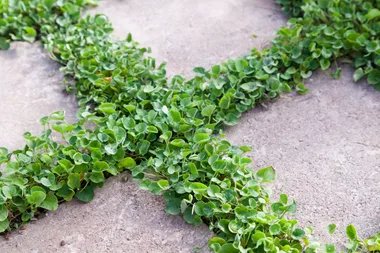
Dichondra is a lawn substitute you can plant in sunny or shady areas. Spread by stolons (aka runners), it quickly forms a dense mat. Insignificant yellow flowers emerge year-round and produce seeds that float to other areas of your garden. Keep an eye out as it’s a vigorous coloniser.
Try these as well:
Climbers
These quiet magicians provide greenery and softness without taking over your land. They turn bare walls, imperfect fences and pergolas into lush, living wall hangings. They burst with seasonal colour and fragrance without taking focus from your garden’s attention grabbers. And the bonus? They also provide privacy!
Tip for climbing plants
Many climbers can’t support their own weight as they grow so need help from a trellis, fence or chicken wire.

Native wisteria
(Hardenbergia violacea)
This has masses of tiny deep-violet or white flowers produced in sprays in late winter and early spring. It climbs with twining stems.

Creeping fig
(Ficus pumila)
A vigorous evergreen with small, heart-shaped foliage that quickly covers masonry walls and fences. It climbs with aerial rootlets along its stems that secrete a strong, latex adhesive.

Orange trumpet vine
(Pyrostegia venusta)
This climber creates a brilliant late-winter glow when it’s smothered with orange, trumpet-shaped flowers. It climbs with twining tendrils.

Sweet pea
(Lathyrus odoratus)
A quick-growing annual that, when draped over a fence in spring, brings romance with its perfumed, pastel flowers. It climbs with
slender, curly tendrils.

Bougainvillea
Bougainvillea flowers are tiny – it’s the stunning paper-like bracts in pink, red, purple, orange and white that draw the eye in summer. It climbs by using sharp, hooked thorns to anchor its vining stems.

Clematis
These flowers arrive in spring in so many vibrant colours. It climbs by using the leaves and stems as tendrils. It’s best planted with its roots in the shade, and it will climb towards the light.
Try these as well: