
Love the look of gum trees, but worried your backyard isn’t big enough? While their twisting branches, fragrant leaves, and fluffy blossoms are hard to resist, a full-grown eucalyptus can take up a lot of space.
That’s where smaller varieties come in. They bring the character of a gum tree closer to home, with blossoms you can enjoy from the garden and a welcome food source for visiting wildlife. Here are our top picks.
KEY TAKEAWAYS
- Dwarf gum trees bring flowers, fragrance and wildlife into suburban gardens.
- Check the mature size before planting.
- Dwarf lemon-scented gums such as ‘Baby Citro’ and ‘Lemon Essence’ grow to about 6m.
- For colourful flowers, consider a dwarf flowering gum.
- For lemon-scented foliage, choose a dwarf Corymbia citriodora.
How to grow a dwarf lemon-scented gum
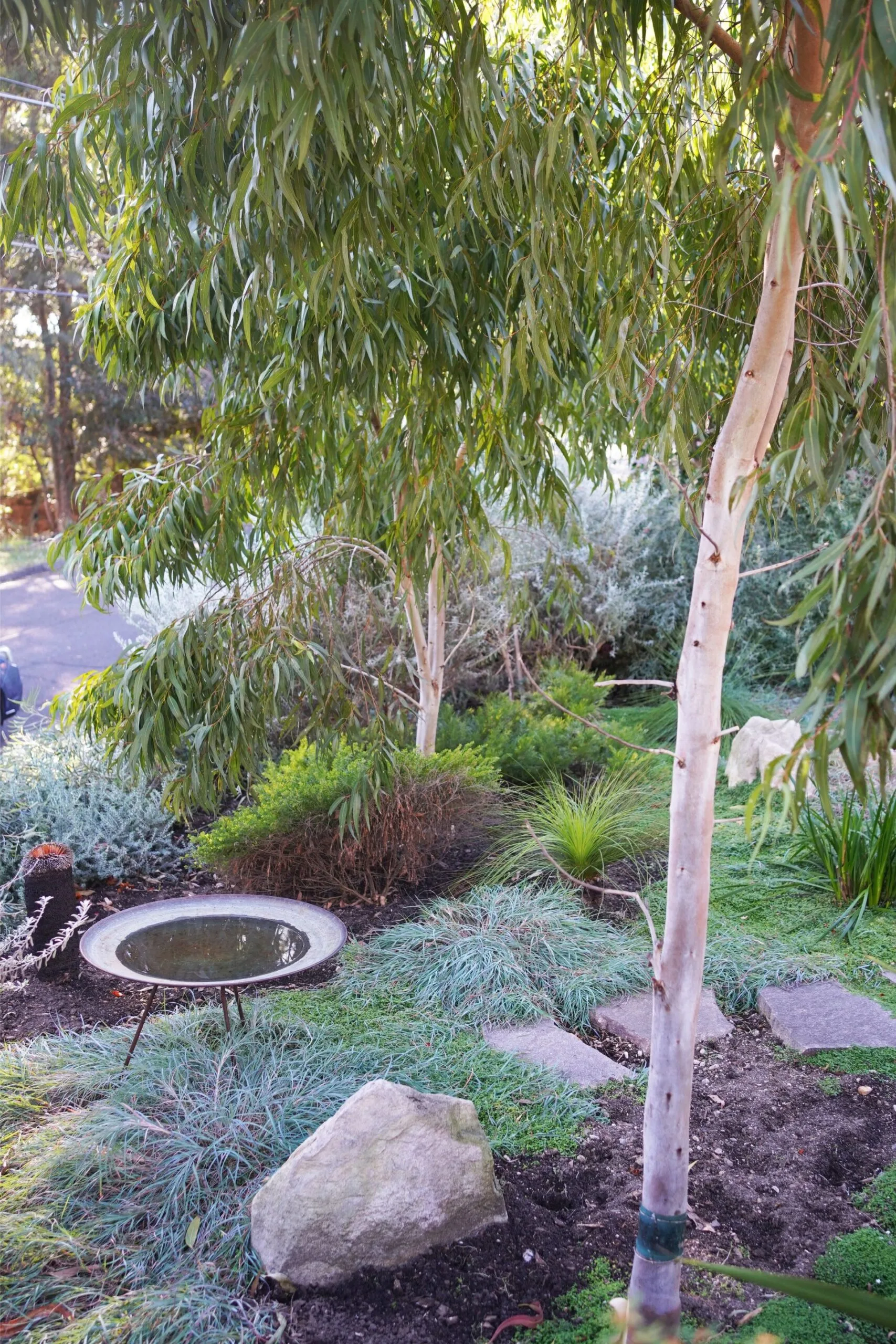
Landscape designer Kath Gadd creates modern gardens using only Australian native plants. One of her favourite gums is the lemon-scented gum (Corymbia citriodora), which gets extremely tall in the bush and tends to drop its branches in strong winds.
Kathy uses several dwarf grafted forms when designing urban gardens, including ‘Baby Citro’ and ‘Lemon Essence’, which grow to about 6m instead of 40m as you find in the bush. ‘Scentuous’, another grafted variety, grows a little taller, to 8m.
The key things required for growing these gums, says Kath, are full sun and well-drained soil. They flower within two years after planting, producing clusters of creamy white, nectar-rich flowers, from late winter through summer. The fluffy blooms are actually a mass of stamens rather than petals.
“It has a beautiful, natural shape, but I prune after it’s finished flowering so it doesn’t grow straight up and develops a denser foliage,” she says.
Like all gum trees, they’ll attract possums and native birds, especially rainbow lorikeets and other nectar eaters when they’re in flower.
“If the tree is weakened in some way, pardalotes and other small wrens come looking for scale, aphids and lerps,” explains Kath.
They don’t drop branches like their grown-up relatives, but their leaves will drop, “especially when cockatoos come looking for grubs”.
Top small gum trees for small gardens

Flowering gum – Corymbia ficifolia
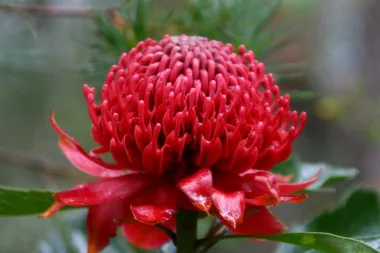
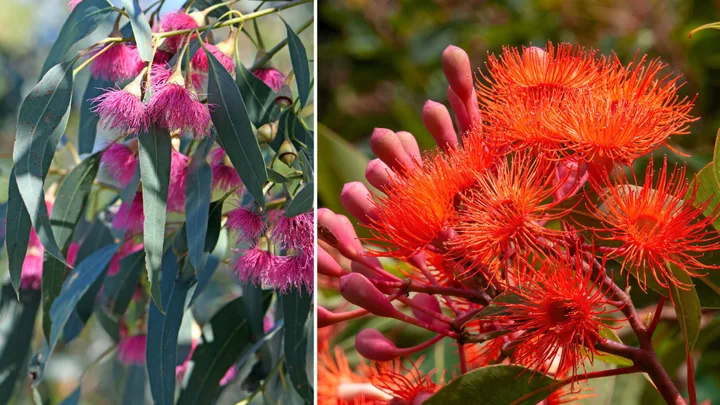
One of the first gums that was successfully bred for gardens was Corymbia ficifolia, Western Australia’s famous flowering gum. Numerous dwarf hybrids are now available, including ‘Baby Orange’, ‘Baby Crimson’, ‘Baby Scarlet’, ‘Mini Red’, ‘Wild Sunset’ and ‘Wildfire’. All produce rich red or orange-coloured flowers followed by huge gumnuts. ‘Fairy Floss’ has gentle pink and white flowers.
The bark is persistent, meaning it’s retained on the tree. It becomes furrowed as it ages, shedding occasionally in stringy strips. Trees grow to about 3–4m, with some varieties to 6m.

Eucalyptus caesia ‘Silver Princess’
If you’re into royalty, no gum is quite so elegant as Eucalyptus caesia ‘Silver Princess’, also originally from Western Australia. It’s renowned for its weeping branches, dangling, narrow, blue-green foliage and clusters of large pink or red flowers in winter to spring.
These are followed by large, urn-shaped gumnuts covered with a silver, powdery residue. Its ghostly white, powdery bark turns brown each season as it ages, then in late summer it peels off in curls to reveal fresh, shimmering skin underneath. It grows to about 5–8m.

Eucalyptus leucoxylon ‘Euky Dwarf’
If you’re after winter colour, Eucalyptus leucoxylon ‘Euky Dwarf’ brings it in spades. Pink, red, or cream flowers light up your garden from autumn through to spring, sometimes even into mid-summer. The blooms give nectar-feeding birds a rare treat.
Barrel-shaped gumnuts follow the flowers. It has a smooth, creamy bark that turns to varying dark shades as it ages, then peels off in flakes or ribbons to reveal fresh mottled skin underneath. It grows to 7m.

Corymbia ptychocarpa hybrids
The ‘Summer Beauty’, ‘Summer Glory’ and ‘Summer Red’ hybrids of Corymbia ptychocarpa typically produce large clusters of pretty ballerina-pink flowers in summer, but they can come in white or red. The bark is thick, rough and persistent, ageing into a distinctive tessellated pattern.
These trees are renowned for producing very large, highly ornamental and distinctly ribbed gumnuts, sometimes up to 5cm long. Grows to about 5m.

Eucalyptus websteriana
Mallee gums don’t produce a single trunk but have many emerging from a lignotuber – or a root that is a mass of dormant buds. This allows them to quickly resprout after fires.
One of the most popular for the garden is Eucalyptus websteriana, originally from Western Australia. It’s a small tree with distinctive waxy, heart-shaped leaves. It produces small, fluffy yellow flowers in spring and summer, followed by ornamental, bell-shaped gumnuts that are covered in a white, waxy coating. The rich, glowing reddish-brown bark peels back in thin, curly strings. Grows to 4m.

Dwarf Corymbia citriodora
The lemon-scented gum (Corymbia citriodora) is a favourite of many bushwalkers because of its refreshing citronella perfume. Modified to domestic size, the dwarf variety has a narrow, dome-shaped weeping habit. The smooth pinkish trunk, often slightly mottled with white, sheds its bark in thin flakes.
From late winter through to summer, there’s a beautiful display of sparkling creamy white flowers, followed by distinctive, small, urn-shaped gumnuts. But the highlight is its graceful, lemon-scented foliage. Grows to 6m.
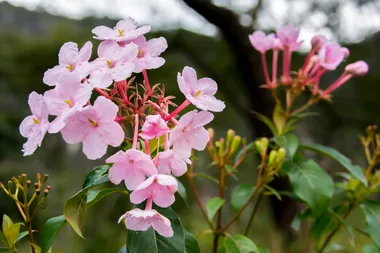
The three main eucalypt genera are Eucalyptus, Corymbia and Angophora. “Gum tree” is a common name rather than a strict botanical category.
The name refers to the sticky substance that some trees release when their bark is damaged.

Related stories
Native ad body.
Native ad body.

Native ad body.
How to keep your summer lawn pristine