

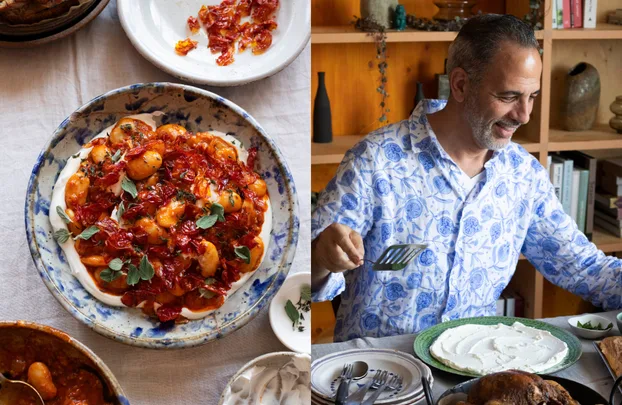
The globally loved chef Yotam Ottolenghi believes that when it comes to cooking, comfort food, simplicity and shutting off your devices matter more than ever.
“People are so exposed to food through their screens,” he says. “They think that every time they cook it needs to look like an incredible Instagram video.”
He’s a successful chef and restaurateur, but perhaps best known for his internationally best-selling cookbooks, Ottolenghi is, quite simply, a household name. I interviewed him about his cooking style, the importance of food to culture, and some of his favourite flavours, ahead of his upcoming tour to Australia.
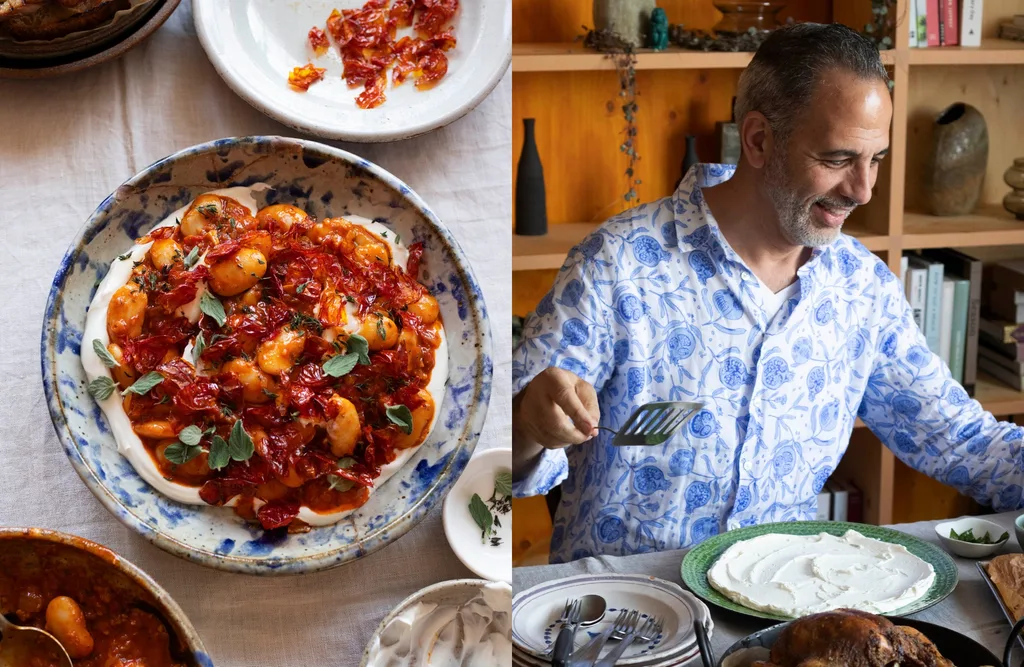
How to sum up his cooking? With cookbooks named; Plenty, Simple and Comfort, perhaps the answer is obvious. Like other superstar chefs Jamie or Nigella, Ottolenghi has become a shorthand for a certain kind of home cooking that’s generous, flavour-packed and surprisingly achievable.
“I want to show people that they can create the most incredible, joyful meal without the stress and anxiety,” Ottolenghi says. “Because I think what happens often is that people associate an elaborate meal with lots of flavours, with stress, like a huge undertaking. And in actual fact you can do things quite easily if you master some key recipes that become your staples.” His live shows are about taking down the barrier for cooking, and showing people that you can get joy and generosity from food, with less effort.
Watch the full interview
How social media is changing the way we cook at home
We discussed our very digital world, where pressures don’t just come from time, feeding a family of fussy eaters or even budget. Now, we have the additional comparison of social media platforms like Instagram (versus reality!). We feel the pressure to create slick experience, and go to social media for cooking advice. But these videos are just showing cooking, he says. “It’s not real cooking. Real cooking involves just, cooking, without a camera. Heaven forbid.”
“I want to just show that people can do it very easily and immerse themselves, and shut the world out – by which I mean, their devices – and just go into the kitchen and cook.”
“Real cooking involves just, cooking, without a camera. Heaven forbid.” – Yotam Ottolenghi
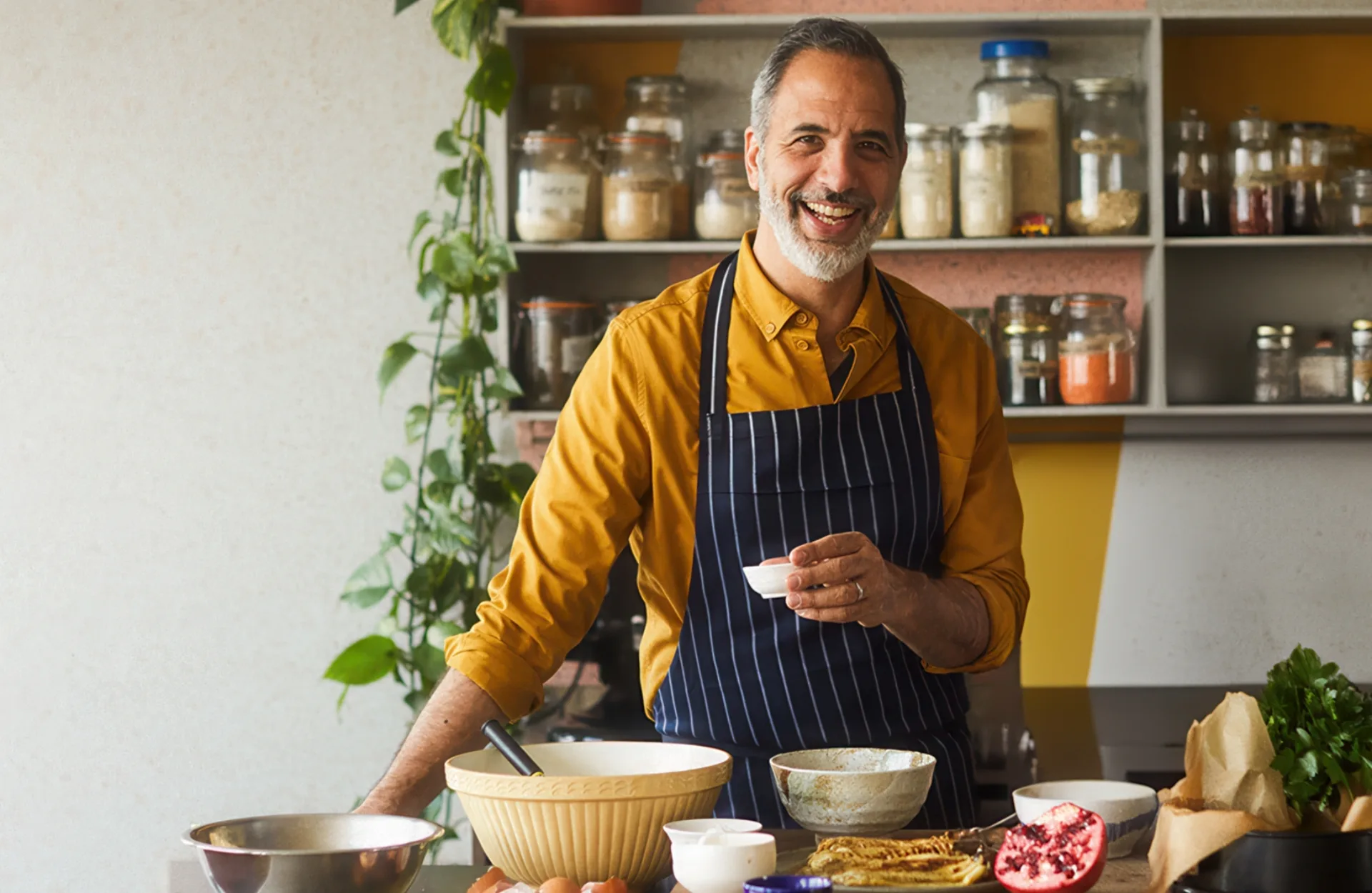
Ottolenghi’s approach to comfort food and everyday recipes
We compare his style of cooking to that performative and aesthetic focus on social media, and he claims while some chefs do impressive technical things with cooking, “I’m not that kind of chef.” “I’ve always been someone who was much more attracted to home cooking with simple techniques.”
“I think now more than ever people do look for things that are just wholesome and comforting and easy. People spend more time at home now than they did in the past. There’s a certain degree of safety that we feel at home because it’s a mad world out there.”
“I think now more than ever people do look for things that are just wholesome and comforting and easy.” – Yotam Ottolenghi
The balance between familiar favourites and creative cooking
We know that BHG readers love familiarity and comfort – give them a pie (sweet or savoury), a roast pork, a pumpkin soup or an easy traybake and they will be happy – but, they also adore something creative.
I explain to him that our readers tend to gravitate towards those recipes that are familiar and easy, but also the ones that have that creative edge, or something fresh and innovative about them. It’s a balance Ottolenghi knows well – many of his recipes and cookbooks have that similar balance of the familiar and the fresh.
“This tension that you’re talking about is what I spend most of my time doing,” Ottolenghi says. “Looking at something and saying, ‘this is what it is, it’s delicious. But what’s the innovation?’”
And he admits, his cookbooks hold a lot of classic, foolproof, basic recipes without reinventing the wheel. But when it does come to that fresh lens? Sometimes it’s as simple as a change in format. “You know, something that might have been cooked in a pan, serving it in a cake tin and it has a size that looks more like a pie.” Sometimes, it’s something more. “Other times it’s about adding flavour and mixing and matching up things which come from different parts of the world, or different parts of the kitchen.”
He does admit that sometimes they push the envelope. There’s a perfect example of this in his book, Comfort, which features two recipes for Bolognese. “One of them… ragu bianco, which captures the essence of the ragu that my father, who was Italian, used to make.”
“And then there is this kind of crazy ragu, which is the Helen’s [Goh] Bolognese, which kind of has Chinese flavours, which is really not – if you are a purist – it’s not a Bolognese at all.” This version has classic elements like beef and pappardelle, but it shakes things up with star anise, ginger, soy, and it’s topped with quick pickled cucumber and coriander. “It’s nothing like [a Bolognese], but it kind of elicits those kind of emotions… It’s super comforting,” Ottolenghi says.
Cooking for family: Yotam Ottolenghi on kids, taste and patience
I ponder if this innovation in making things fresh and different, while celebrating tradition is all in an endeavour to spark that moment, and that love of food in your audience. He mentions meatballs had a lot of strong memories for him growing up, and now he makes them for his kids.
“I always end up talking about meatballs,” Ottolenghi jokes. “We also have a stroganoff meatball version in the book. Again, my mum used to like meatballs and she used to make beef stroganoff, so putting those together was kind of like mashing up the cultures of the dishes.”
Even Ottolenghi admits his kids have had various stages – like all kids, he feels – where their palate took time to develop. “It’s just a natural process with kids that you just need to let it take its course, rather than push it.”
I tell him it would be a crime if his kids didn’t love food, having a father so instrumental to the food world and he reassures me: “My kids love food. It’s not always my food, but they do love food,” he laughs. “Sometimes they watch cooking on Instagram or YouTube, and they come back and they say ‘Oh I want to make this’. They have no idea what that thing is.”
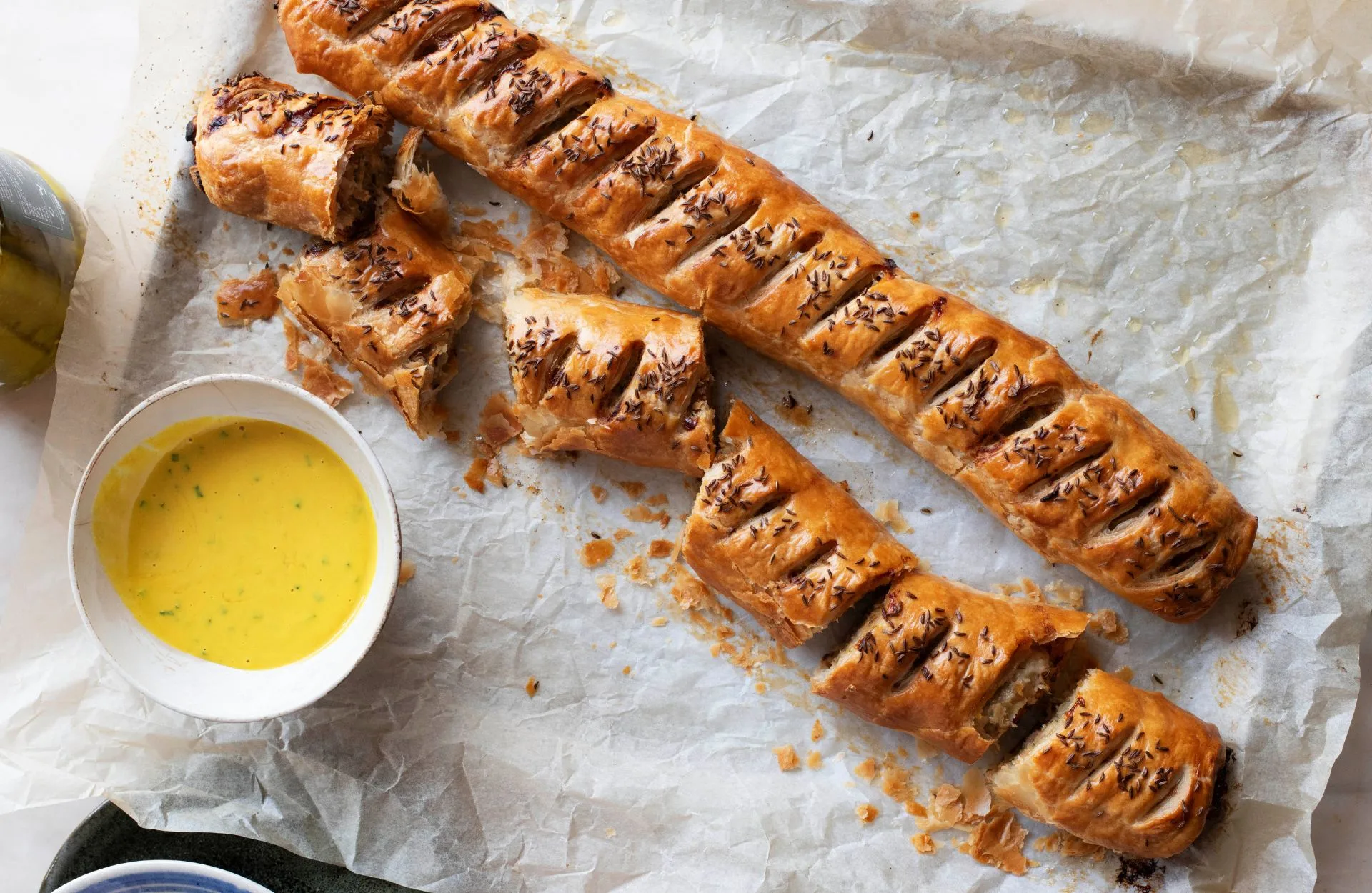
The emotional power of food and nostalgia
We talk about food and the culture food is shaped by having a formative impact on our lives, impacting long-term comfort and nostalgia. Ottolenghi believes food is so important, in part because of its practicality. “It’s just something that kind of sees us through life,” he says. When he looks back on his life, “there’s always been food that’s been changing and reflecting where I was, what was happening, who was cooking, who was feeding and who was eating. And I think those moments are really crucial in building up our sense of identity, of who we are.”
“And this is why we get that kind of emotional satisfaction, or sometimes dissatisfaction with something that we eat.” For him, this sparks memories of a Dutch apple cake he used to eat in the 90s when he lived in Amsterdam. “Every time I eat the cake, or actually any apple cake, it just immediately takes me back to that world. Because I didn’t grow up with apple cakes, and then all of sudden; wow, that’s so good!”
“I think we are very susceptible to finding meaning and joy in food because it has that kind of power of taking us to points of the past and also telling something about who we are.”
Ottolenghi’s favourite ingredients, flavours and kitchen tools
We enter a rapid-fire round of questions, aimed at uncovering Ottolenghi’s favourite things:
Vegetable: “Cauliflower.”
Fruit: “Peach.”
Herb: “You’re killing me,” Ottolenghi groans, “coriander”. He laughs and agrees when I call him out on his answer being polarising.
Favourite kitchen tool: “Garlic crush.”
Favourite meal to make when you don’t feel like cooking: “Warmed up rice with grated pecorino and black pepper. Oh, and butter.” I tell him I’m definitely trying this. “Think about it like cacio e pepe but with rice.” You can use fresh rice or day-old rice, he advises.
Chocolate or vanilla: “Chocolate.”
Parma or parmi: “I don’t understand the question,” Ottolenghi laughs. When I tell him about the playful war we have on how to shorten chicken parmigiana, he answers, “Okay, I’ll have to be more Italian here and go for Parma, like the city. But I know that parmi sounds more Australian.”
When asked what his favourite meal to make is, Ottolenghi talks enthusiastically about long weekend lunches that he shares with family and friends. “It’s just the kind of meal that takes a long time. I call it the meandering meal, because you start off at lunch time and you can still be there eating and drinking at like 7pm in the evening. There’s no time limit, there’s no stress.”
In a world obsessed with optimisation, performance and perfection, Ottolenghi’s message feels quietly radical: cook simply, generously, and let food do what it does best – bring people back to themselves, find joy, and leave stress behind.
Find tickets to see Ottolenghi on tour when he visits Australia.
Adelaide, Perth, Melbourne tickets via Ticketek.
Hobart, Sydney and Auckland via Ticketmaster.

Related stories

Native ad body.

Native ad body.




Native ad body.