
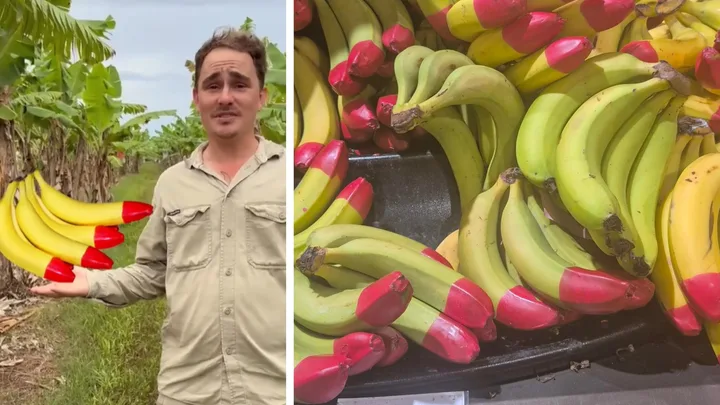
While browsing the fruit aisle at your local supermarket, you may have stopped in the banana section and wondered: Why do some have a waxy red tip? It’s something TikTok users have been pondering over recently. Surprisingly, red-tipped bananas have nothing to do with flavour or variety, but rather, how they’re grown.
Eco Bananas farmer Dylan took to TikTok to explain the meaning behind the red wax tips. “Those red tips mean we don’t use insecticides, we use insects instead!” he says. “We’re about building healthy soils and protecting the Great Barrier Reef.”
A red-tipped banana is dipped in red wax to signal a very special growing process called ‘Ecoganics’. Here’s why red-tipped bananas exist, how ecoganics farming helps support sustainability, and why they’re, well, just better.
The history of the red-tipped banana
It all started 20 years ago, when Australian produce growers, Frank and Dianne Sciaccia, witnessed the degradation of the Great Barrier Reef and the changes to the ecosystem first-hand. This inspired Frank to develop a new way of farming – one that would help solve the imbalances created by conventional farming methods.
Frank shared, “We wanted to farm differently, with nature at the heart of what we do. Nature keeps everything in balance, and understanding the natural capital you have available to you enables you to get rid of all the harmful chemicals. The result is a farming method that is good for the environment and at the same time produces far superior bananas, just as nature intended.”


What is Ecoganics?
Ecoganics is a farming method that uses no pesticides (natural or chemical-based) and instead uses the natural life-cycle of insects to prevent disease and infestation. Instead of using pesticides to get rid of insects, this method uses insects to get rid of insects.
While it may be a more challenging process, it means that the surrounding environment (including waterways that lead to the ocean) is protected from pesticide ingredients that can harm flora and fauna. The Ecoganics bananas may be the most recognisable because of their red tips, but this farming method has expanded into other fruits and vegetables.
Is ecoganics the same as organic?
No, organic farming means that no chemical-based pesticide is used on crops. However, pesticides and fertilisers made from natural ingredients can still be used, and can have a negative impact on the environment. Ecoganics farming uses no pesticides at all, which preserves the environment and supports biodiversity.
Why red-tipped bananas?
Distinctive Red Tip® Ecoganic® Bananas are dipped in a bright red food-grade wax to let shoppers know that they are different from ordinary bananas. The wax tip indicates that the bananas are grown using the Ecoganic® farming system, which is always 3rd party certified and endorsed by the Great Barrier Reef Foundation.
What about the flavour?
Red Tip® Bananas are firm and fleshy, allowing for easy slicing and are sweet and creamy in flavour.
Where can you buy red-tipped bananas?
Red tip bananas have been available to shoppers at Coles, Woolworths and other leading Australian supermarkets since 2009.
What are the benefits of red-tipped bananas?
The ecoganic method used to grow these bananas does not use any fertilisers or pesticides, neither natural nor chemical. Instead, it relies on nature to grow bananas that taste as nature intended, in turn having a positive impact on the environment, by helping to repair the damage done by conventional farming methods.
Red-tipped vs regular bananas
So, what’s the difference between red-tipped and regular bananas? Let’s break it down.
- Red-tipped bananas use no pesticides (natural or chemical-based) and instead use the natural life-cycle of insects to prevent disease and infestation. On the other hand, regular bananas are often sprayed with pesticides during cultivation to improve efficiency.
- Red-tipped bananas have a slightly sweeter and creamier flavour than regular bananas.
- Red-tipped bananas are more expensive and reflect their slower, smaller-scale production process. Regular bananas are widely available and cheaper.


Related stories

Native ad body.
Native ad body.



Native ad body.