

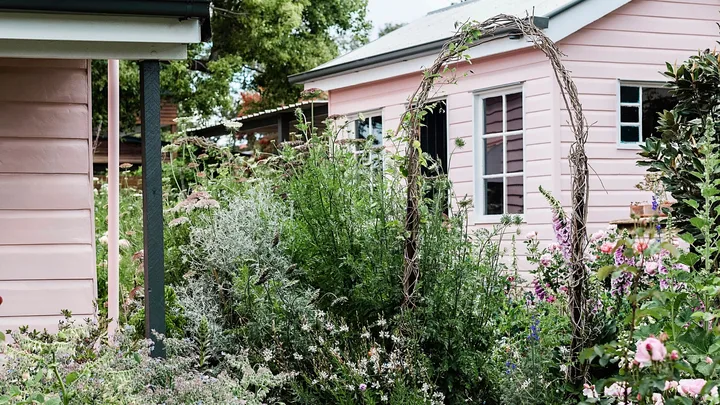
What plants did you grow up with growing in your garden? Memories from the garden hold a special place in everyone’s heart, especially when it comes to plants and flowers.
We asked our Facebook audience, ‘What plant reminds you the most of your childhood?’, and the question garnered over 700 responses. Everyone had a different story to tell about the trees they played under, the plants they made potions with and the flowers that their mums and grandparents always had growing in the garden.
And now we say, it’s time to bring them back! Geraniums, honeysuckle and snowball trees may have been heavily featured in your childhood backyard, but they are sorely missed in today’s Aussie suburbia. We’ve scoured the hundreds of responses from our social media audience and found the flowers that will still look cool in a 2026 garden.
Our favourite nostalgic flowers in Australia

Geranium
(Pelargonium)
These pops of purple aren’t just beautiful to see, they’re also beautiful to smell! Our readers love the delicate scent that geraniums graced them with during their childhood. For a sea of green and deep purple, plant these beauties down a side path, and relish in their lovely smell.
Mature size: 30-60cm in height
Care requirements: Full sun with well-drained and slightly alkaline soil. Can work in all climates, except for very cold areas.

Choko vine
(Sechium edule)
Choko vine is an Aussie classic – whether it was grown outside the kitchen window or on the back fence. Many remember picking chokos to eat raw, make pickles from, or use as a substitute in their apple pies. While not too flavourful, it’s filling and extremely abundant. Any beginner gardener will love this vine to cover up ugly spots in the garden, and give great harvests year-round!
Mature size: 6-12 metres in length, with sufficient support
Care requirements: Full sun to partly shady. Need well-drained soil and regular watering. Suitable for all climate zones.

Hydrangea
(Hydrangea)
Ah, the beautiful hydrangea. There aren’t many BHG readers who don’t have some lovely memory of a hydrangea from childhood. Hydrangeas may still be quite popular, but this is a call out for more and more! White hydrangea is beloved by the more minimal gardener, but we love the bright bursts of blue, pink and purple. Have a hydrangea already? You can change the flower’s colour yourself, by making slight changes to the soil.
Mature size: Ranging from 0.5m to over 4m in height, depending on variety.
Care requirements: Partly shady, with morning sun. Needs fertile, well-drained soil and moderate watering. Suitable for sub-tropical, temperate and cool climates.

Honeysuckle
(Lonicera)
Honeysuckle is another vine that dominated Australian backyards in the 70s and 80s. Acting as a great cover for unsightly fences and sheds, this plant also elicited a sweet, honey scent. One reader mentioned that their honeysuckle lived on the privacy screen for their outdoor dunny! Even though outdoor dunnies are long gone from Aussie households, the honeysuckle still lives on as a beautiful vine on fences and around arbours.
Mature size: Depending on variety, from 1.9m to 9m in height.
Care requirements: Full sun to part shade, with plenty of space for climbing. Temperature to sub-tropical climates are most suitable.

Peppercorn tree
(Schinus molle)
The peppercorn tree is something many remember playing under as children, including Digital Editor Tahni Mesann. She can remember visiting a giant tree near her school, saying she would ride down with friends and “play under the branches – it was just like a cubby house.”
While it is called a peppercorn tree, it does not produce traditional ‘peppercorns’, and instead has pink peppercorn fruit that is often used in cooking. If you’ve got the space, then this large tree is definitely worth it, for the shade and playing capabilities!
Mature size: 9 to 15 metres in height.
Care requirements: Full sun with free-draining soil. Suitable for all climates.

Boronia
(Boronia)
Boronia is a genus of native Australian plants that has over 150 species located across Australia. It’s no surprise that so many people love this shrubby native! With cute star-shaped flowers (often in pink) and small pointed leaves, boronia is a beautiful addition to any garden, no matter the species you choose.
Mature size: Can grow up to 2.5 metres in height, depending on species.
Care requirements: Part shade to filtered sun. Well-drained, slightly acidic soil. Best suited to warm, coastal climates.

Daphne
(Daphne odora)
Daphne has always been a favourite among mothers and grandmothers. While this plant is hard to grow in hotter climates, many readers recall its beautiful fragrance, with comments such as “the smell was divine” and “the perfume travelled through the house”. If you live in a temperate or cooler climate, this is the perfect plant to bring perfume to the garden.
Mature size: 1 to 1.5 metres in both height and width.
Care requirements: Full sun to partly shady, with well-drained, acidic soil. Best suited to cool and temperate climates.

Freesia
(Freesia alba)
Freesia may be considered more of a ‘grandma’ flower than most, but we have to say, the grandmas knew what they were doing! These little flowers have a great scent, and the flower is as cute as can be.
If you do want a few freesias dotted around your garden, make sure to check local council requirements before planting. This one, while adorable, is seen as an invasive weed in some parts of the country.
Mature size: 25-60cm in height.
Care requirements: Full sun to partly shady. Suited to most climates, excluding tropical.

Geraldton wax
(Chamelaucium uncinatum)
As one of Australia’s most famous wildflowers, this is definitely a nostalgic flower for many. With luscious pink, red or white flowers and tiny, narrow leaves, it makes for a unique addition to the garden. The best part of this plant? Picking posies for your kitchen bench or dinner table!
Mature size: 2 to 4 metres in height, and 2 to 3 metres in width.
Care requirements: Full sun to part shade, with well-drained soil. Best suited for temperate climates.

Maidenhair fern
(Adiantum)
For all the indoor plant lovers, the maidenhair fern is always in the top ten list. This plant’s flowing, delicate leaves make for an interesting plant to hang from a shelf or sit pretty in a corner. Many readers talked of visiting grandparents who had this fern living in window boxes and balcony pots.
Mature size: 30-60cm in height and width.
Care requirements: Filtered sun, with protection from the afternoon sun. Well-drained soil and regular watering are needed.

May bush
(Spiraea cantoniensis)
May bush is a delight to have in the garden. Dubbed ‘the wedding bush’ by one Facebook commenter, who played weddings as a child, using the flowers, this bush is truly a sight to behold. Although it doesn’t flower in May in the Southern Hemisphere, this plant will bloom beautifully in spring.
Mature size: 1.5 to 2.5 metres in height and 1.5 to 3 metres in width.
Care requirements: Full sun to partly shaded. Best suited to cool climates, and needs protection from hot afternoon sun.

Mulberry tree
(Morus)
A mulberry tree was a staple for many Australian streets. Many readers remember picking mulberries on the way home from school, or keeping silkworms in a shoebox and feeding them from the tree. These are perfect for hiding from the hot summer sun, and of course, have the most delicious fruit to snack on!
Mature size: 8 to 15 metres in height.
Care requirements: Full sun, well-draining soil with plenty of organic matter. Is suitable for all climates.

Snapdragon
(Antirrhinum)
Snapdragon is one of those flowers that ends up on every cottage garden plant list. And, in Australia, there’s no denying that our mums and nans loved a good cottage garden. These tall spears of colour make a backyard look lively and whimsical, without too much work involved. Pair these with shorter ground covers to keep your wonderland garden full of life.
Mature size: 15cm to 1.2m in height.
Care requirements: Full sun and well-draining soil. Is suitable for all climates.

Snowball tree
(Viburnum opulus)
Viburnum is still used across Aussie gardens as a screening plant and hedge, but the snowball tree has been left behind its sister varieties. These white balls of flowers are reminiscent of a hydrangea, but have much more toughness in them. Wait for spring to come around, and marvel in these large balls of pearly white!
Mature size: 3 to 4m in height.
Care requirements: Full to partial sun with well-draining soil. Suitable for temperate and cooler climates.

Sweet pea
(Lathyrus odoratus)
Sweet pea definitely needs to be brought back to the Aussie home garden. Not only is it a pretty little plant, but it also comes with a lovely tradition. Planting sweet peas on St. Patrick’s Day in Australia is an honoured tradition, one that is said to bring bigger, more fragrant flowers come spring.
Mature size: 60cm to 2.5m in height.
Care requirements: Full sun with fertile soil and regular watering. Suitable for all climates.

Yesterday, today and tomorrow
(Brunsfelsia pauciflora)
How could our nostalgic flowers list be complete without this sweet plant? Yesterday, today and tomorrow says everything you need to know in its name. These flowers start at a bright purple before fading to lilac and into white, replicating the transition of time. Not only that, but this bush has a floral scent both day and night!
Mature size: 1.5m to 2.5m in height.
Care requirements: Sunny to partly shady position with moist, well-drained soil. Subtropical and temperate climates are preferred for this plant.
Other nostalgic flowers from Australian gardens
There were hundreds of flowers, plants and trees that the Better Homes and Gardens readers remembered and loved from their childhood backyards. Here are a few more that were mentioned that would thrive in a 21st-century garden! We’re not going to mention the comments about bindis (ouch), stinging nettles (double ouch) and blackberry bushes (we know, they’re hard to get rid of).
- Begonias
- Azaleas
- Sweet William
- Gladioli
- Dahlias
- Lavender
- Daisies
- Wisteria
- Violets
- Marigolds
- Fuschias
- Port wine magnolia
- Roses
- Status
- Gardenias
- Frangipani
- Lambs ears
- Stock
- Portulacca
- Forget-me-nots
- Jasmine
- Gerberas
- Strawberries
- Nasturtiums
- Golden rod
- Iris

